6/6/12

My Experiance as a Living-in Nanny (for a Japanese Family)

 I might have mentioned in a previews post that I was going on working holiday to Utah.
Which is why I've been absent these past few weeks.
 I am still here until June 12th.
 I'm here to take care of a 3 year old for two weeks.
 (My previous teacher's son)
 He only speaks Japanese and understands very little English.
This forces me to speak in Japanese, but really just the basics.

 I have however, memorized words from constant use. Either new words or a conjugation of an old one I studied but never used. For example, I now have no difficulty to remember how to say 「上げて」
 I hear Japanese all day long between him and his mother.
I can understand a lot more now then when I arrived, but I still feel my speaking ability is just the same.

My flow of my reading-aloud ability has improved a bit from reading to him at least 30 minutes a day.
With some of the books I understand what is going on, while with others I'm not sure.
That's still a big improvement!

I don't think I'm learning as much as I could for a couple of reasons
. I can't always ask or look up words I'm constantly hearing.
 I don't have time to write them down. I hesitate to speak only in Japanese to his mother.
 I planned to study grammar and vocab with Erin's challenge while I'm here, and review Genki in my short breaks. My laptop went bust so those things are inaccessible. (I'm writing from an iPad)

 As important and great as it is to be immersed in a Japanese environment, I feel it can't work fully on its own. At least not for me. I need to study grammar and understand sentence structure.
And I always need to review. I need to look things up when I write in my journal.
I suppose I'm a little frustrated that my pre-study plans back fired, and that I will feel more behind when I begin my summer challenge when I return home.
And that I rely heavily on books. (and that I can't afford a new laptop)

 One cool thing though is that I've been going to a Japanese church here every Sunday.
 The meeting is a mix of Japanese and English, and the church community is made of not just Japanese. There's a lot of interesting people there. From people that experienced being in the Japanese camps, ni-sei and san-sei, Japanese major students, exchange student, and interracial couples.
I can see that even though most have forgotten how to speak Japanese, they are still very in-tune with their Japanese heritage.

 Everyone here is also very nice! I've been able to make a couple of new acquaintances, and have similar interests beyond Japanese. Yai!
 Tomorrow I will be meeting another Japanese.
I feel I won't speak out of hesitation. (story of my life)
 I have filmed my stay here so in some distant future look forward to that.

5/11/12

Preparation for Summer Challenge: MANGA!


One of the important aspects of immersion is having material that you really enjoy. I had children's books and a couple of manga before, but I wasn't really in love with them. So I decided to stock up on reading material that I would enjoy this summer. At first it was hard to find anything that I was interested in, and if I did find something, it was too expensive. But to my delight I got series I've wanted to get my hands on.


The first series I bought is the Emma light novel. This is based on Kaoru Mori's manga Emma. I always wanted to own a light novel series. 


At the moment I think the novel is above my level, but I think it's still good to have something advanced for when you to enjoy in the future. 


Of course I had to buy Emma! I have the anime series and the English version of the manga. So reading it in Japanese is just natural since I love the story so much!


The manga has no 振り仮名(ふりがな)so I plan to use it as 漢字 practice. I know the story well so it won't bother me that I don't understand the conversations 100%. 


A Bride's Story is a series I haven't read. So I don't know the story at all. This also has no 振り仮名. I think this manga will be good to read when I'll be able to understand what I'm reading. (Though that's if I don't buy the English version by then...)


The Story of the Land of Colored Clouds is an anime I had found accidentally, and I'm so glad I did! I just finished watching Season 1, and love it so much I just had to get the 漫画. I only got 4 of the 9 in the series and I hope to complete my collection. The manga is based on the light novel series which I hope to purchase as well. 


This series has 振り仮名! I'm really glad at least one of the series I purchased has it. This means I can take it along with me and enjoy just reading without worrying about looking up 漢字 readings. I might take these with me on vacation. (I'm afraid of loosing them though T^T) I won't understand everything word for word, but I know the story so it shouldn't be a problem. I'm interested to see the similarities and differences in translation from Japanese to English. 


As I mentioned in the vlog, I purchased these on ebay. I found a shop that specializes in printed Japanese material. I will definitively be purchasing from there again. The seller also takes requests for manga series you're looking for! Awesome! http://stores.ebay.com/fromnippon
You can buy all items mentioned at this store. I also saw some of this stuff on yesasia. Whichever you feel most comfortable with. 

I hope you enjoyed this entry and found it helpful. Where do you shop for your Japanese books? Let me know! Any series you're dying to read?


4/18/12

Meetup #3

During the long weekend I got the chance to hang out with レイチェルちゃん again. I also got the chance to sleep over. (やった!)
I feel a lot more comfortable riding the train now. During the ride to ボストン I finishing reading ダーリンは外国人in English. The story was OK, and it wasn't enjoyable enough for me to want to read it in Japanese. I thought it was a romantic story, but that's not the case. I didn't like the couple in it either. There are a lot of good example sentences of everyday expressions one can use though. The translation too was a tad bit off I think. I think I'll come back to it at a later time. 


レイチェル picked me up from the station and we went to the Japanese lunch square like we always do. She treated me to our favorite delicious smoothie, and I treated us to Japanese baked goods. For some reason it never hit me to try the stuff there. I've always wanted to try Japanese bakery food, and Meaphe's videos about them got me VERY curious. (And jelly) I was going to buy melon pan but it quickly ran out!
As we looked around I asked レイチェル how order food in Japanese. I wanted to practice the counters. To my disappointment the person at the bakery was not Japanese. 
 I always wanted to try this treat! Never thought I'd get to so soon.I remember seeing it in lucky star and really wanted to it. Though I'm not positive if it is the same dish.
 The second item I bought was bread filled with curry. 美味しかった~
 This was レイチェル's treat, but I don't remember what it was. 


We also went to a supermarket that has a bakery and I bought メロンパン! It was as tasty as I imagined it would be. We made rice and curry for diner. レイチェル's curry is the best I've ever had. ♥_♥


We spend the day chatting about our Japanese learning journey and other things. She showed me her book collection. There's something warm and comforting seeing a shelf full of books. We then spent the rest of the day watching MLP and the Legend of Korra. 


We both hope that eventually we'll be brave enough to publicly vlog. I hardly filmed or I would forget too. So I hope in the future to make up for it. I would write my experiences with レイチェル in Japanese for practice, but I need to get these up ASAP. I don't have the extra time I would need to do so. ごめん


I hope to learn to make these in the future!


Video I took over her house.


4/16/12

Immersion: Tools I use

I realized I have never shared what I use to immerse myself in Japanese.
I thought it'd be fun to share that, and hopefully you might find something useful here.


iTouch Apps

I am very much addicted to my iTouch. 
It's a pocket-computer for me.
I'm never without it.
I also changed the language setting to Japanese.

Before I even get out of bed I listen to Daily Audio Bible Japan. (Free)
Each day a chapter of the Bible is read. The female reader is relaxing to listen to.
(I'm very picky about voices when it comes to podcasts). I don't understand much of what is being read, but I'm sure a higher level learner will know from where they are reading. They say it in the beginning and if you have a Japanese Bible you can read a long. Each podcast is less than 10 minutes.
Now there is a Daily Audio Bible by the same team in English. But they do not read the same passage as the Japanese version. There's also a Proverbs podcast and I hope that they'll make one in Japanese also. 


A podcast I like to listen to before bed is one called Japanese Classical Literature at Bedtime. (Free) This one also has a nice female voice. This one I would say is advanced. I have no clue what is going on. It is good nonetheless. If you like classical literature I recommend this podcast.


I have no idea how I found this one, nor how to pronounce the title. This one comes with a free book and other stories available for purchase. Again, a nice soft voice to listen to. The text appears on screen as she reads. It's good practice to improve reading speed and see how the sentences would be read. You can skip to a certain page, pause and come back, or have no sound. 


The books you own are archived and you can select to see the written text as a whole. You can see by who and when it was written. The story that comes along free with the app is a very old and famous work. 
I have not bought any other books on the app yet, but I plan to in the future. I enjoy reading a long.


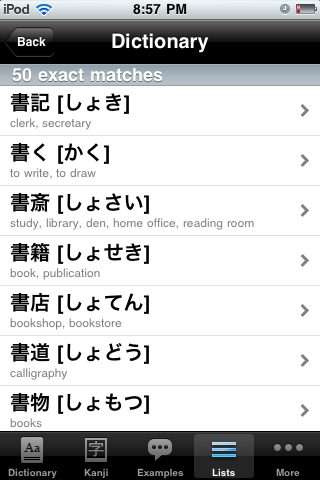
This is probably the most popular app for Japanese. (free) Kotoba is a electric dictionary. One thing I really like is that it does not need wi-fi. You can:
Search in dictionary either in romanji or kanji, see the stroke order of kanji, example sentences, conjugation in either formal or informal, look up kanji by school grade or JLPT level, and save words into custom folders. 
This is SO much better than traditional dictionaries!


On-line sources

Before using anki I used Asahi kanji. I still like using this to test myself. There is also an iTouch app for this. N5 is free on the app but then you have to buy the rest. The website is completely free. 

I love using this site to read stories. Some of the stories have a recording so you can listen and read along. Great for comprehension and improve reading speed. The recordings are also downloadable so you can carry it along with you.

Erin's Challenge is great. It is a free program that was once a paid material. It has skits with the dialog written, review questions, manga, and a lot more things. It is a nice interactive course. If I didn't have Genki this would be my main tool.

I follow a lot of blogs, but I focus on two main ones: JALUP and Tofugu. JALUP is more of a guide blog. It has many good entries that help clear up the muddle and difficulties of learning Japanese. Tofugu has many entries on different topics, and the tips for improving on how to learn Japanese are helpful.

I like reading Rachel's site for motivation and seeing how another immersion method learner is learning. 
I read this Japanese blog for entertainment on a topic I enjoy.

Recently I am in a 小グループ on google+ that meets once a month. We are all Japanese learners and are slowly trying to make our group be fully in Japanese. 
Skype is another great tool if you have friends in Japan, YouTubers, or mixi buddies.

When I'm on the computer I use Denshi Jisho as my online dictionary. When I want to know what a kanji means or how to pronounce it, I use Rikaikun. You simply scroll over the word and it will show you the meaning and how to read it. My social network sites are all in Japanese.

Desktop

I think there is enough information out there about Anki. So I will simply say it is a great tool.
I've recently bought 30 day eBook from Tofugu which I hope will help me with my studies.
I love using Evernote to organize helpful information I've found online for Japanese. Tofugu has a good article about this here.

Out and about

Rachel suggested to me the idea of making CDs of episodes of dramas or anime to listen to when on the commute. It is enjoyable and a challenge. This helps to really focus on the dialog instead of subtitles or the action on screen.
I keep a little memo that I take to work. I write down vocabulary I want to learn and keep it with me at all times. 
When I feel like learning Japanese through video games I play My Japanese Coach. I think it's a nice leisure way to study.When I want to focus on writing Kanji I like to use 美文字トレーニング. I also have a children's calligraphy set if I feel like going old-school. 

That is pretty much it. I was thinking of doing what books I use and shows I own in a separate post with video. Would you guys be interested in seeing that? Would YouTubers I follow be interesting too? I'd do it sometime in May.

 I hope this post was helpful.
Let me know what podcast, apps, sites, blogs, and games you use. I'd really like to know! 


I do not lay claim to any of the images used.

4/10/12

春休みチャレンジ: Results, Thoughts, Future Goals

I know this post is very late!
Better late than never.


This challenge was really enjoyable.
I implemented a new way to learn kanji, 
and I learned some lessons a long the way.


In my progress 1 post I listed tools and resources I thought of using;
YouTube videos, books, games, and blogs.


I decided that videos were not good for this challenge. They are better for listening. Even if a video had subtitles I noticed I ignored them. 


I also didn't like using my video games. I have My Japanese Coach, 
美文字トレーニング, and a new game Rachel gave me. I think Japanese coach is good for grammar and vocabulary building. 美文字トレーニング good for learning stroke order for me right now. The new game made me a bit frustrated.

I have difficulty finding blogs in Japanese that are on topics I'm interested in. I found one that I am excited to start following! It is Japanese blog about many things, but I am only focusing on My Little Pony entries. Since I already know the updates and news in English I can easily jump in. 

The most exciting aspect that I got out of this challenge is that I now have a huge craving to read manga and light novels. Before this challenge I feared jumping into reading books above kid level because I know I won't comprehend what I'm reading. (Like 1リットルの涙) I also thought I shouldn't spend so much money on books I can't read! (Ordering JP books is so expensive T^T)

I've been watching j-dramas and anime lately, and they have made me curious about the written work they're based on. After some searching and hesitation I ordered whole bunch of complete collections of manga and light novels. It was hard on my wallet. I would never spend so much money in one go on any of my hobbies. But I don't feel bad for this. I got books I'm really interested in and some I've been wanting for years. All of them rare and on sale! So it was totally worth it! I will share more about them once the package arrives in May. 

I'm continually adding to my kanji deck and using the radical decks. 
  
The most important lesson that I learned is to be flexible.
I am very hard on myself when I don't accomplish things according to plan.
I always end up putting too much on plate. So I always get discouraged. 
I always feel my best wasn't enough.


Things like school, work, and other responsibility can pile up.
Schedules can become hectic. (My work schedule is not very consistent)
I always feel fatigued. I noticed I tend to get sick almost every other week!
Life happens and I know now it's important to let go and re-plan things.


So even if I couldn't get to a part of the challenge that I told myself I'd do, I didn't drive myself crazy over it. 


So the result? An enjoyable time learning kanji and the world of reading ahead of me!


From here I want to set down my plans for the rest of the year.
I was going to start a challenge right away after this one, but I will postpone till May. It's the end of the semester and I don't want to over do it.
Until then, I will focus on:

  •  reviewing chapters from genki
  •  exploring new and old tools and see what is best for me
  • keep working on kanji and reading
  •  try to write in a journal at least once a week
  • Keep working on immersion
  • Improve my speaking
I won't do these things in a rigid manor. I want to explore and review without a deadline or goal in mind. This will be a preparation for my next challenge.

When May hits I will start a new challenge. The Tofugu 30 days challenge. I bought the e-book when it was on sale. I can't wait to start it! I will also continue to use JALUP as my tool to improve my study methods. I will also be going to Utah for 2 weeks to work as a Nanny for my former Japanese teacher. This will be great opportunity to speak Japanese as much as possible, and immerse myself in the language. 

When I return I will be taking a summer class and continue using the Tofugu e-book. I will also begin reading my new books.

At the moment I am having a difficult decision to make for my fall semester. I am thinking of taking a full-time course-load for school. While also continuing to work part-time. I don't know if I can physically or mentally do it. I also don't know how Japanese would fit in. From my experience in the past my school and Japanese both suffered a lot. My reasoning for going back full-time is so that I can graduate sooner. (I am... very behind).


I plan to go to a Japanese Language School in the summer 2013.


A lot came up going through this challenge. I am still figuring out the best way to go about learning kanji. Learning Japanese is an ongoing process and you have to revamp study methods as your skills improve. It also made me plan ahead. (I live in the present. I can't think so far ahead) Very unexpected from a kanji challenge ?_?


I hope your studies are going well.
頑張ってね。

3/24/12

春休みチャレンジ: Progress 2

Yesterday I started building my on-yomi deck.
I put int the kanji from Chapter 1 of the Genki Kanji book.
I already know these characters, but I still don't know all of their readings.
Everyday I plan to add 1 chapter of kanji into my deck. 
I'm not sure if I should study kun-yomi reading at the same time.
I feel like I'll jumble them up if I do.

I reviewed radicals in Anki, and I was surprised to see that I enjoyed it!
The thought of learning radicals seemed like a bore, but I'm having fun learning what each radical means. Some I can see what they represent, but others not at all! 

I'll be honest for a moment. I'm enjoying this challenge so much that I studied kanji instead of doing my assignments. ^^;; I forgot how much I enjoyed learning Kanji. I wanted to stay up late and keep studying. But I'm not a night person and I was nodding off. One of the best things to do for your study is to get a good nights sleep.

Today I worked a dreary shift. When I got into my car the first thought was, "I want to go study Kanji". This made me so happy. Usually I think about what show I want to watch. I am feeling quite exhausted but I didn't want to go to sleep without doing some studying.

First I reviewed radicals from the Textfugu deck. So many of them I recognized right away. It feels great when your mind brings back what you've learned. So my review was pretty quick. I then went to the other radical deck. I am now confused because some of the radicals in that deck have very different meanings. The radicals also have so many different ways of pronunciation. Is it important to know the names of the radicals? Should I bother learning them or just stick to knowing what they mean? I don't know.

 I looked over my book and it explains that I only have to memorize the 16 radicals to know the kanji of that book. I will add these to my on-yomi deck as extra cards. They will be the main ones that I need to know, but I do not want to stop learning the rest of the radicals. 

I added chapter 2 into my on-yomi deck. Radicals are definitively easier to learn ><. I'm wondering how one knows when to use on-yomi or kun-yomi when reading a new word. I vaguely remember Mattias from tias90 channel talking about it. I will have to re-watch his Kanji tips video. I remember taking notes. I'll have to find my notebook in my mess. ^^''

I haven't had time to use Ering's challenge site or write journal entries for my challenge. I'm not going to be hard on myself though. A part of these challenges is for me to learn how to juggle school, work, and Japanese. I have to pick and choose what learning materials will be best for that day.

That's all for today!
皆も頑張ってくださいね。